Source Document
Manual of Regulations for Banks
BSP.MORB.2023.Sec903.p2.OBL3
Manual of Regulations for Banks > 903 SCOPE OF REGULATIONS > 903
Obligation Summary
For these regulations a bank together with its branches and offices is deemed a single unit, so AML/CFT obligations apply to the whole entity as one.
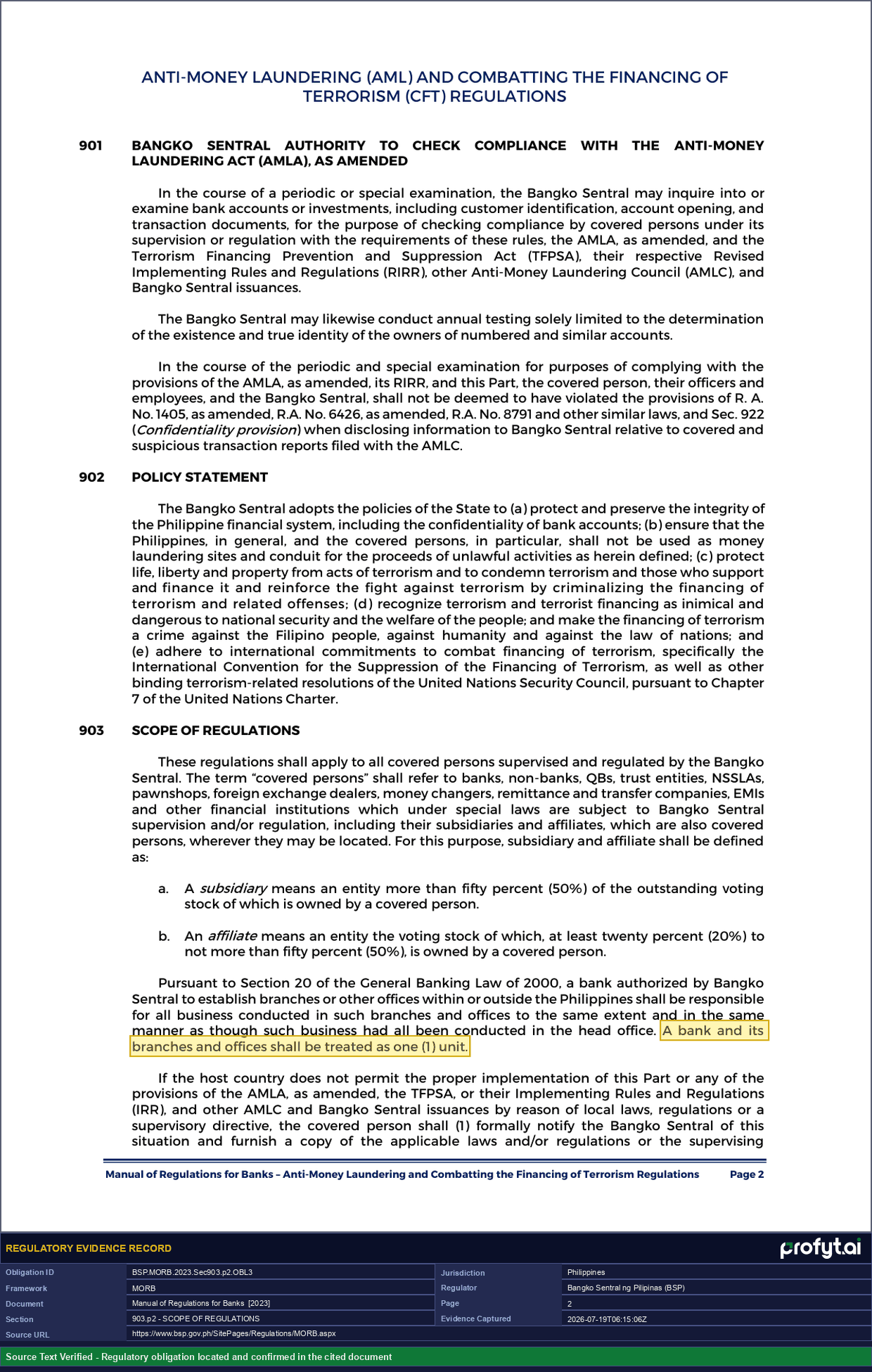
A bank and its branches and offices shall be treated as one (1) unit.
MORB, Sec. 903, p. 2 (2023 ed.) · Manual of Regulations for Banks · p. 2
a. A subsidiary means an entity more than fifty percent (50%) of the outstanding voting stock of which is owned by a covered person. b. An affiliate means an entity the voting stock of which, at least twenty percent (20%) to not more than fifty percent (50%), is owned by a covered person.
Pursuant to Section 20 of the General Banking Law of 2000, a bank authorized by Bangko Sentral to establish branches or other offices within or outside the Philippines shall be responsible for all business conducted in such branches and offices to the same extent and in the same manner as though such business had all been conducted in the head office. A bank and its branches and offices shall be treated as one (1) unit.
If the host country does not permit the proper implementation of this Part or any of the provisions of the AMLA, as amended, the TFPSA, or their Implementing Rules and Regulations (IRR), and other AMLC and Bangko Sentral issuances by reason of local laws, regulations or a supervisory directive, the covered person shall (1) formally notify the Bangko Sentral of this situation and furnish a copy of the applicable laws and/or regulations or the supervising
What This Requires.
ProfytAI Regulatory Intelligence
Type: requirementRequires that a bank and all of its branches and offices be treated as a single unit.
Relationship
Second in the same lettered 'b' sequence under Sec903; follows the head-office responsibility obligation (OBL1) and precedes the host-country notification duty (OBL3), amplifying the single-entity concept established in OBL1.
Why This Exists
Reinforces head-office accountability by making single-entity treatment an explicit organizational rule rather than leaving it implied.
Implementation Considerations
Typically involves consolidating governance, risk management, and compliance treatment across the bank and its branch/office network rather than administering them separately.
Interpretation Note · 'One (1) unit' is a structural characterization of the bank-and-branches relationship, not a numeric or quantitative threshold.
This explanation is generated regulatory intelligence, traceable to the citation above.
The byte-exact verbatim text remains the authority you cite.
The captured source page, with this duty highlighted and stamped with its obligation ID, section, and page.
Reproduced from the Bangko Sentral ng Pilipinas Manual of Regulations for Banks, retrieved from bsp.gov.ph. Highlighting and the verification stamp were added by ProfytAI; the underlying text is unaltered. This document is freely available from the BSP website.