Source Document
Manual of Regulations for Banks
BSP.MORB.2023.Sec905.p10.OBL1
Manual of Regulations for Banks > 905 BASIC PRINCIPLES AND POLICIES TO COMBAT MONEY LAUNDERING > 905
Obligation Summary
Requires every covered person to embed the five basic AML/CTF principles into its operations: ethical conduct and safety/soundness, robust know-your-customer, a sound AML/TF risk-management system, full legal compliance with a culture of compliance, and full cooperation with the AMLC.
In line with the declaration of policy, covered persons shall apply the following principles:
MORB, Sec. 905, p. 10 (2023 ed.) · Manual of Regulations for Banks · p. 10
In line with the declaration of policy, covered persons shall apply the following principles:
a. Conduct business in conformity with high ethical standards in order to protect its safety and soundness as well as the integrity of the national banking and financial system;
What This Requires.
ProfytAI Regulatory Intelligence
Type: requirementRequires covered persons to apply the set of principles listed in this section, in line with the section's declared AML/CFT policy.
Relationship
Opening lead-in obligation of Sec905 (Basic Principles and Policies to Combat Money Laundering); introduces the lettered list of principles that follows, beginning with the ethical-standards item shown in sibling context, none of which are captured as separate obligations in this record set.
Why This Exists
Translates the section's declaration of policy into a concrete duty to adopt operating principles supporting the fight against money laundering and terrorist financing.
Implementation Considerations
Typically involves adopting internal policies, codes of conduct, and governance practices that operationalize each listed principle across the covered person's business.
Interpretation Note · 'The following principles' refers to the enumerated list beginning with the ethical-standards principle; 'declaration of policy' cross-references the section's stated policy rationale rather than quoting it here.
This explanation is generated regulatory intelligence, traceable to the citation above.
The byte-exact verbatim text remains the authority you cite.
The captured source page, with this duty highlighted and stamped with its obligation ID, section, and page.
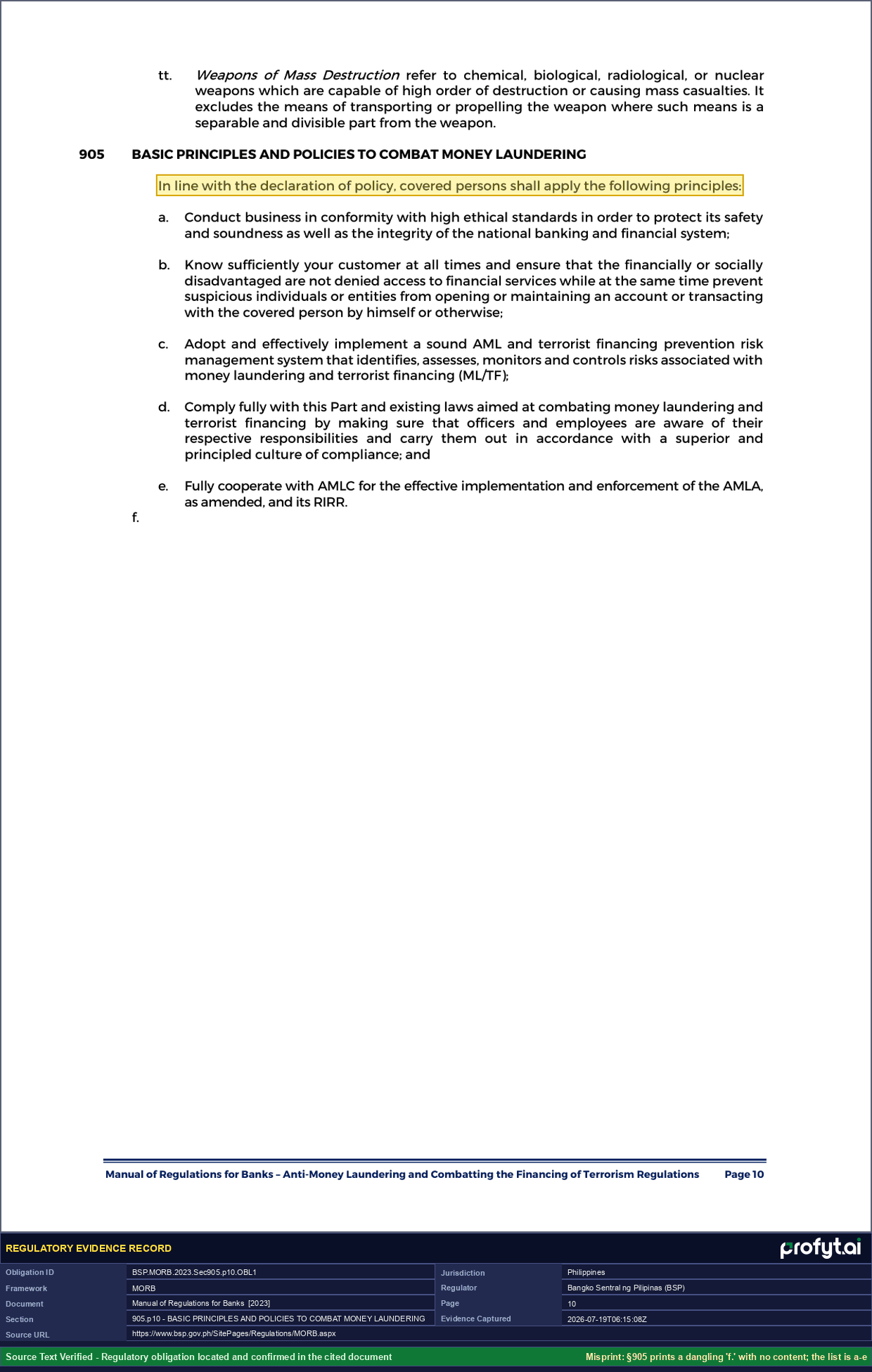
Reproduced from the Bangko Sentral ng Pilipinas Manual of Regulations for Banks, retrieved from bsp.gov.ph. Highlighting and the verification stamp were added by ProfytAI; the underlying text is unaltered. This document is freely available from the BSP website.