Source Document
Manual of Regulations for Banks
BSP.MORB.2023.Sec921.b.p17.OBL1
Manual of Regulations for Banks > 921 CUSTOMER DUE DILIGENCE > Enhanced due diligence (EDD) > b
Obligation Summary
When enhanced due diligence is triggered (required by this Part, by policy, or by higher ML/TF risk), perform the full EDD program on top of routine profiling and transaction monitoring, covering added information gathering, validation, senior-management approval, enhanced monitoring, first-payment routing, and further reasonable measures.
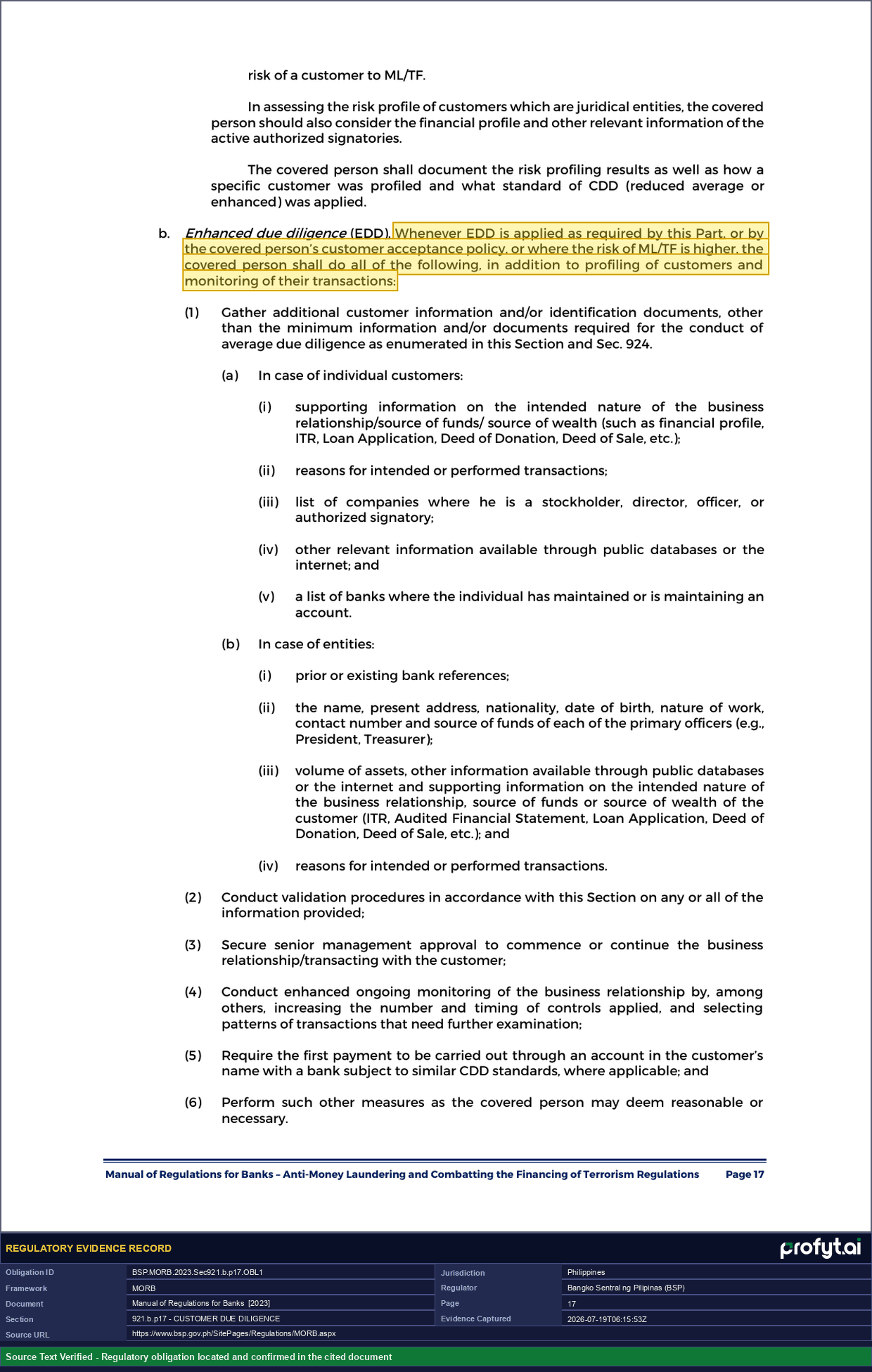
Whenever EDD is applied as required by this Part, or by the covered person’s customer acceptance policy, or where the risk of ML/TF is higher, the covered person shall do all of the following, in addition to profiling of customers and monitoring of their transactions:
MORB, Sec. 921.b, p. 17 (2023 ed.) · Manual of Regulations for Banks · p. 17
The covered person shall document the risk profiling results as well as how a specific customer was profiled and what standard of CDD (reduced average or enhanced) was applied.
b. Enhanced due diligence (EDD). Whenever EDD is applied as required by this Part, or by the covered person’s customer acceptance policy, or where the risk of ML/TF is higher, the covered person shall do all of the following, in addition to profiling of customers and monitoring of their transactions:
(1) Gather additional customer information and/or identification documents, other than the minimum information and/or documents required for the conduct of average due diligence as enumerated in this Section and Sec. 924.
What This Requires.
ProfytAI Regulatory Intelligence
Type: requirementRequires a covered person, whenever enhanced due diligence (EDD) is triggered by regulation, its own customer acceptance policy, or heightened ML/TF risk, to carry out a defined set of additional measures on top of ordinary customer profiling and transaction monitoring.
Relationship
This is the lead-in for subsection 921.b's enhanced due diligence measures, positioned between the customer due diligence trigger conditions on the preceding page and the consequence for failed verification that follows on the next page; the specific measures it introduces are enumerated later in the same subsection.
Why This Exists
Ensures that once a customer or transaction is identified as higher-risk, the bank layers on a heightened, standardized set of controls rather than relying on baseline due diligence alone, matching the risk-based approach BSP expects for AML/CFT supervision.
Implementation Considerations
Complying typically means maintaining a documented EDD procedure that adds defined verification and monitoring steps on top of standard onboarding whenever any one of the three triggers applies, with the applicable trigger recorded for each customer.
Interpretation Note · Any one of the three triggers (regulatory requirement, internal acceptance policy, or elevated ML/TF risk) is sufficient on its own to invoke EDD. The required measures are additive - 'in addition to' - not a substitute for ordinary profiling and monitoring.
This explanation is generated regulatory intelligence, traceable to the citation above.
The byte-exact verbatim text remains the authority you cite.
The captured source page, with this duty highlighted and stamped with its obligation ID, section, and page.