Source Document
Manual of Regulations for Banks
BSP.MORB.2023.Sec924.p35.OBL2
Manual of Regulations for Banks > 924 RECORD KEEPING > 924
Obligation Summary
Keep all transaction records and documents safely stored for five years measured from the transaction date.
All transaction records and documents of covered persons shall be maintained and safely stored for five (5) years from the date of transaction.
MORB, Sec. 924, p. 35 (2023 ed.) · Manual of Regulations for Banks · p. 35
All customer identification records of covered persons shall be maintained and safely stored as long as the account exists. All transaction records and documents of covered persons shall be maintained and safely stored for five (5) years from the date of transaction.
Said records and files shall contain the full and true identity of the owners or holders of the accounts involved in the transactions such as the ID card and photo of individual customers and the documents mentioned in Sec. 921 (Customer identification) for entities, customer information file, signature card of authorized signatory/ies, and all other pertinent customer identification documents as well as all factual circumstances and records involved in the transaction. Covered persons shall undertake the necessary adequate security measures to ensure the confidentiality of such files, including all information shared by the group-wide compliance. Covered persons shall prepare and maintain documentation, in accordance with the aforementioned client identification requirements, on their customer accounts relationships and transactions such that any account, relationship or transaction can be reconstructed as to enable the AMLC, and/or the courts to establish an audit trail for money laundering.
What This Requires.
ProfytAI Regulatory Intelligence
Type: requirementRequires covered persons to keep and securely store all transaction records and documents for five years from the date of the transaction.
Relationship
Paired with the preceding paragraph on customer identification records (OBL1) to set the section's two baseline retention triggers; the content, security, and audit-trail duties that follow (OBL3-OBL5) build on both.
Why This Exists
Preserves a verifiable transaction trail long enough for BSP examiners, the AMLC, and courts to reconstruct past dealings and investigate potential money laundering after the fact.
Implementation Considerations
Complying typically involves a retention schedule keyed to transaction date, with periodic disposal review to avoid both premature destruction and indefinite over-retention.
Interpretation Note · The five-year clock runs from the transaction date; a later paragraph in this section sets a different five-year period keyed to account closure or relationship termination, and the two should not be conflated.
This explanation is generated regulatory intelligence, traceable to the citation above.
The byte-exact verbatim text remains the authority you cite.
The captured source page, with this duty highlighted and stamped with its obligation ID, section, and page.
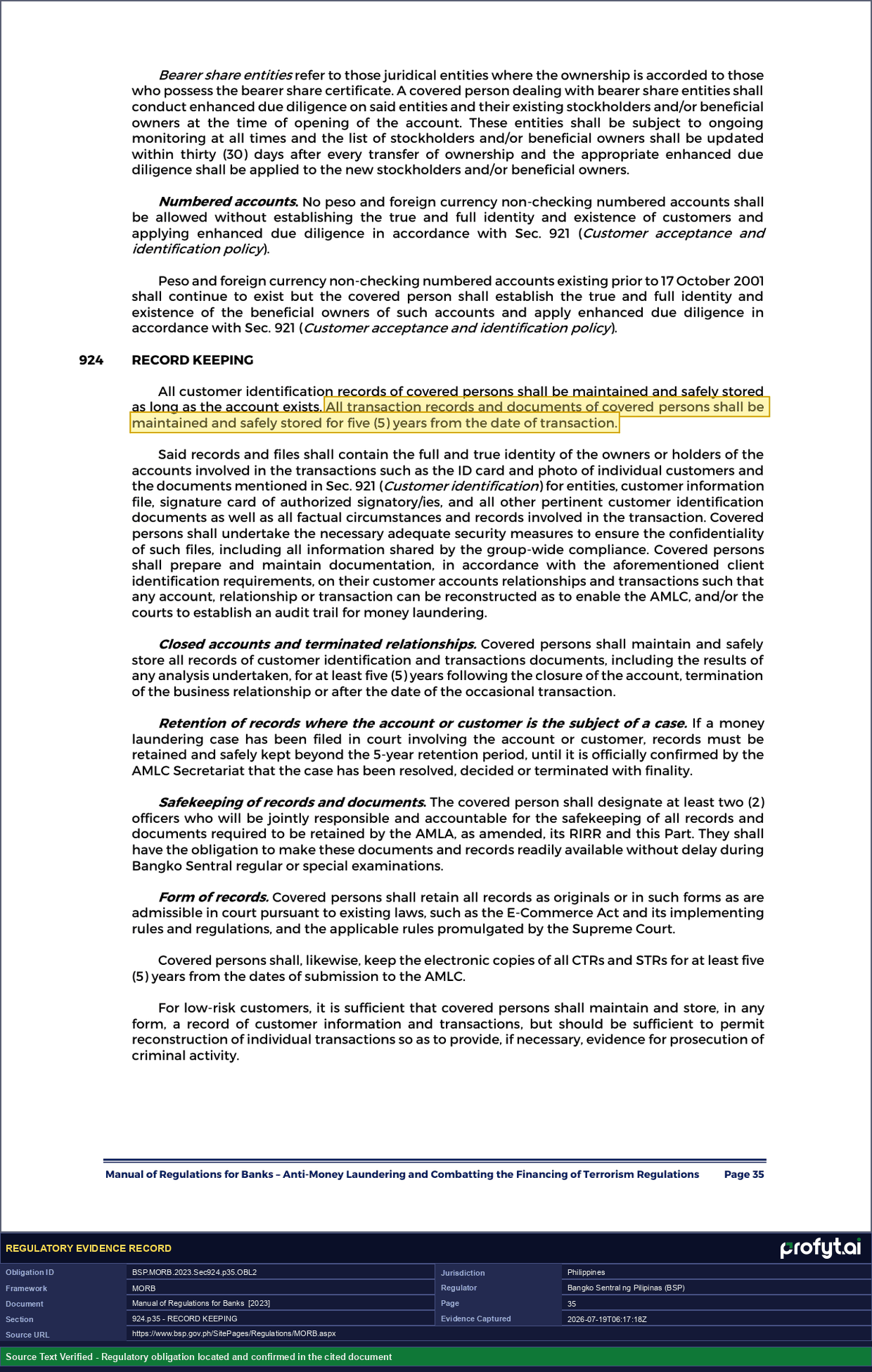
Reproduced from the Bangko Sentral ng Pilipinas Manual of Regulations for Banks, retrieved from bsp.gov.ph. Highlighting and the verification stamp were added by ProfytAI; the underlying text is unaltered. This document is freely available from the BSP website.